

Fluxfall is a falling-block puzzle built around closed energy loops instead of complete rows. Pipe modules descend from the top of the board. Move and rotate them until their connectors line up. When a network has no open end left, the loop disappears and makes room for the next pieces. The first levels are deliberately gentle, while later rounds ask for more planning. Large outer loops can clear trapped blocks, and a charged Breaker removes one awkward tile when space gets tight. You can play free online, with no download, on both mobile and desktop.
What kind of puzzle game is Fluxfall?
Fluxfall looks familiar at first glance: pieces appear above a narrow grid, fall downward and have to be placed before the board fills up. The important part, however, is completely different from the usual line-clearing formula. Filling a horizontal row does not clear it. Every tile carries a section of pipe, and the useful question is not “Where is the gap in this row?” but “Where can these connectors lead?”
That change gives the game a different rhythm from a conventional block puzzler. Compact stacking is not always the best move. An empty pocket may be exactly what you need for a later corner, and an unfinished branch can be useful if the next module shown in the preview fits it. Fluxfall quickly becomes a game of space management, route building and short-term planning.
How do you play Fluxfall?
The current module falls from the top of the board. Use the left and right controls to choose its column, rotate it when the pipe direction needs to change, and use Drop when you want it to land immediately. On a phone, the main controls sit below the board so your thumb does not cover the puzzle itself.
The connectors on neighbouring tiles only count as linked when they face one another. A pipe ending on the right needs a matching connection on the left of the adjacent tile; the same rule applies vertically. As a result, two blocks can sit next to each other without belonging to the same network.
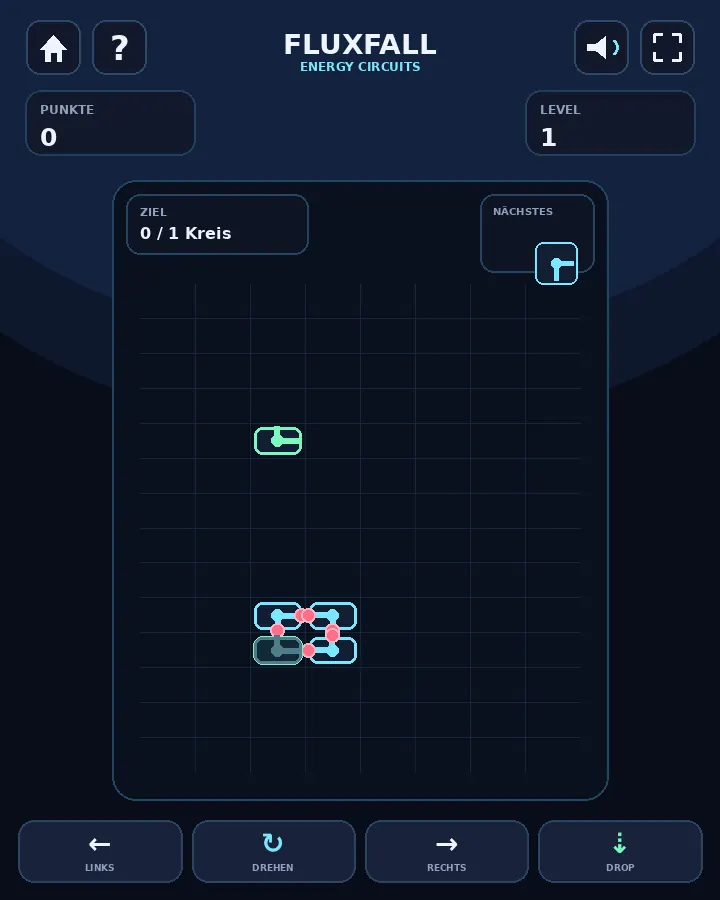
The first stage teaches this without a long instruction screen. Three sides of a tiny circuit are already in place and one matching corner is missing. The falling module is prepared for that gap, so your first successful action comes within seconds. Later, the game removes these safeguards and lets you build freely.
How do the red open-end markers help?
Open pipe ends are one of the most important things to read on the board. In the early levels Fluxfall marks them with red dots. These markers are not danger zones; they are visual reminders that the current network still needs another connection at that point.
That makes it easier to distinguish a promising unfinished circuit from a section that has become awkward to reach. If several open ends are buried near the bottom, repairing every one of them may be inefficient. If they remain accessible from above or from the side, you can often keep building until a larger loop emerges.
Keep an eye on the next-module preview as well. Suppose the active piece could close a small loop immediately, but the next piece is the corner you need for a larger structure. Leaving the first route open for one more turn may create much more space a moment later. Fluxfall rewards that kind of modest forward planning without forcing you to calculate many moves ahead.
Why are large outer loops so useful?
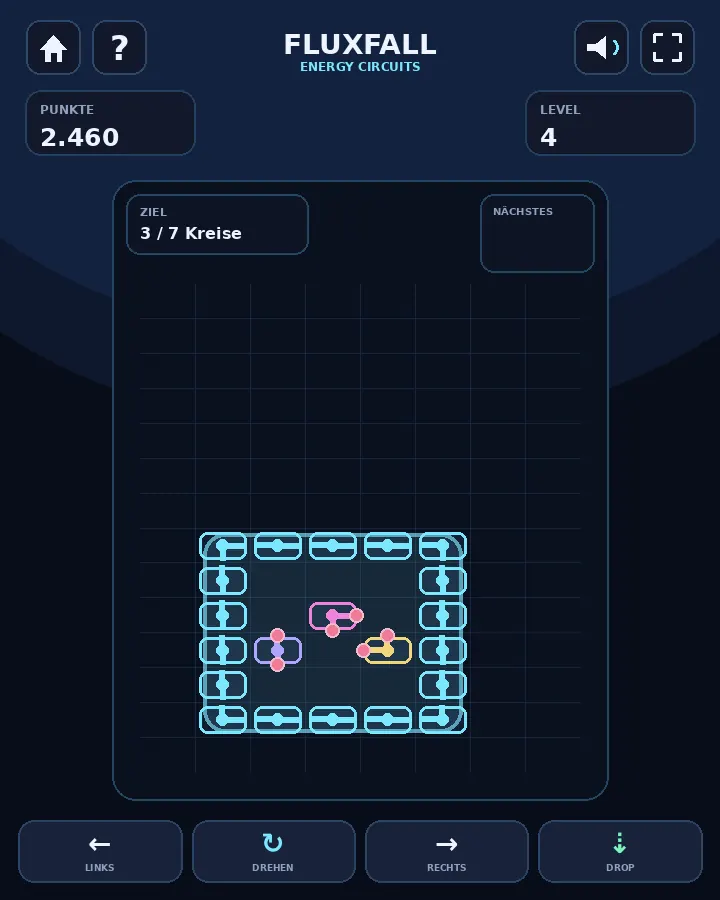
A badly placed module does not have to remain on the board forever. Fluxfall includes a recovery rule that turns a messy area into a new objective: build a closed outer loop around it.
If a sufficiently large circuit surrounds older, unhelpful blocks and the outer pipe has no open ends, the enclosed material is cleared together with the finished loop. This matters most near the bottom of the board, where one or two inaccessible pieces can otherwise reduce your options for many turns.
The mechanic changes how mistakes feel. Instead of treating every poor placement as permanent damage, you can decide whether it is worth repairing directly or whether it would be better to route around the whole area. A large loop requires more room and more pieces, so it is not a free reset. When it works, though, it can open a substantial section of the grid in one move.
What does the Breaker do?
Sometimes there is not enough room to build an outer circuit. A single tile may be blocking the only useful route through the lower part of the board. That is what the Breaker is for.
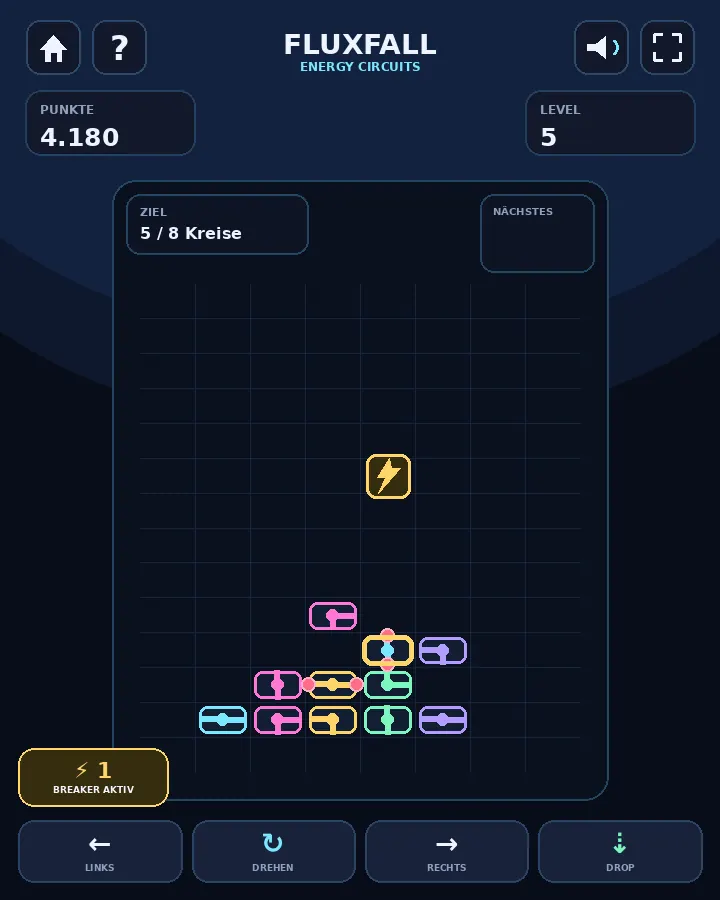
After several successful circuits, the game awards a Breaker charge. It appears in the control bar rather than on top of the playing field, which is particularly important on a small phone screen. Activate it, choose the column you want and drop it. The Breaker targets the first occupied block below its position and removes that tile.
The tool is deliberately precise rather than a large-area bomb. A well-chosen target can reopen an important route; if the selected column has no valid target, the current version returns the charge.
Is Fluxfall designed for phones?
Yes. The game has been developed primarily for a smartphone display. Movement, rotation and Drop use large buttons below the grid, while secondary actions such as help, sound and fullscreen sit in a compact bar at the top. The Breaker joins the lower controls only when a charge is available, so it does not permanently steal space from the board.
Fluxfall also works on a computer. Keyboard controls are available alongside the on-screen buttons, so the same browser game can be played without installing a separate desktop or mobile app. For anyone looking for a free online puzzle game without download, that makes it easy to start a quick round and leave again just as quickly.
Simple strategy tips for longer runs
Protect the lower centre of the board. Open ends near the side can often be approached from one direction, while a crowded central area can block several future routes at once. Keeping a little breathing room in the bottom half is usually more valuable than filling every gap immediately.
Use the preview rather than reacting blindly. The next module is visible for a reason. If the following piece solves an awkward connection, place the current one somewhere that preserves access to it.
Do not repair every mistake at once. A disconnected tile is annoying, but trying to reach it with several unsuitable modules may create a larger problem. Consider whether an outer loop can absorb the entire area later.
Save Breakers for structural problems. The best target is usually not the highest block or the ugliest one. Look for a tile whose removal opens a channel, exposes two useful connectors or makes a large circuit possible.
Fluxfall FAQ
Do complete rows disappear in Fluxfall?
No. Rows have no special clearing rule. Only closed pipe networks are removed, so the shape of a successful circuit can vary across the board.
What do the red dots mean?
They mark open pipe ends. A network containing one of those exposed connectors is not yet complete.
Can I get rid of blocks that can no longer be connected?
Yes. You can surround problem blocks with a sufficiently large closed outer loop. When the loop is completed, enclosed blocks are cleared as well.
How do I earn a Breaker?
In the current version, a Breaker charge is awarded after three completed circuits. The available number is shown directly on the Breaker control.
How does the Breaker choose its target?
After activation, move it to a column and drop it. It removes the first occupied block below it. If that column has no target, the charge is returned.
Does the game get faster?
Yes. The opening levels are intentionally slow and guided. Later levels increase the falling speed and use a broader selection of modules.
Can I play Fluxfall on a mobile phone?
Yes. The controls and layout are designed for small touchscreens, with fullscreen and sound controls included where the browser supports them.
Is Fluxfall free to play online?
Yes. Fluxfall is designed as a free browser puzzle game and does not require an app download.
What is the main goal?
Close as many useful energy loops as possible while preventing the board from filling with unreachable pieces. Good placement, outer loops and carefully saved Breakers help you keep the grid playable for longer.
Try a different challenge
PONG tests your paddle timing. STARTRAIL calls for quick reactions, while PRISM BLOCKS lets you find the right places for your blocks.