

Game images and tile layouts
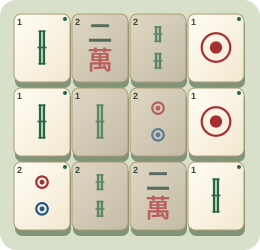
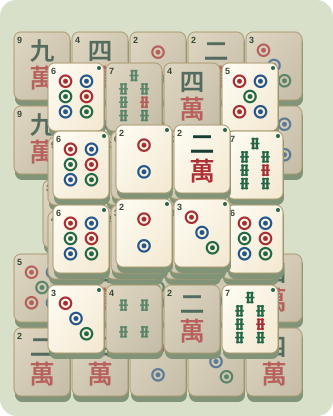

These game illustrations were rendered from actual level data and tile artwork. They are not browser screenshots.
Free online Mahjong with a clear objective
This version of Mahjong is a puzzle for one player. You do not need opponents, knowledge of traditional scoring or a table full of equipment. Your task is to remove every tile from the arrangement. The basic action is simple, but the order matters. An obvious matching symbol may still be trapped underneath another tile, while an ordinary tile at the edge might be holding up an entire row. Looking beyond the first available match makes the game more interesting.
The campaign contains 20 worlds of 25 levels. Beginners can start at level 1, experienced players can enter the campaign at level 40 or 80, and a separate preview lets you try level 350. Campaign entry points save earned stars and continue to the next level. A preview does not award campaign stars. Playing remains free whether or not you choose to support Alexo through the optional donation link.
What is Mahjong Solitaire?
Mahjong Solitaire is a tile-matching puzzle built around access and removal. Tiles are already arranged on the board, often in overlapping layers. You select matching available pairs until the board is empty. There is no race against another player and no countdown in this Alexo version. You can pause to compare symbols, reconsider a selection and study the effect of a possible move before committing to it.
A legal move is not necessarily a safe move. When several copies of the same tile are available, choosing different pairs can produce different remaining positions. Some decisions open useful routes; others leave partners trapped. Every original level in this game has a verified solution, but that does not make every possible sequence successful. If your own choices lead to a blocked position, undo and shuffle remain available to help you continue.
Mahjong rules: when is a tile available?
A tile must satisfy two conditions before you can remove it. Nothing remaining on a higher layer may cover it, and at least one horizontal side must be open. Either the left side or the right side is sufficient. You do not need both sides to be free. Empty space above or below the tile does not count as an open side. Being able to see part of a symbol is also not the same as being allowed to select it.
- Uncovered: no other remaining tile lies over it.
- Open on one side: its left or right edge is accessible.
- A matching partner: the second tile belongs to the same matching group and is also available.
- A complete move: both tiles disappear only after you select the pair.
Brighter surfaces and a small marker help identify available tiles. Still, use position and shape as well as color. On a dense arrangement, check the layer immediately above a tile before looking for its partner. This small habit prevents many apparently mysterious selection problems.
How to play Mahjong Solitaire for beginners
Start at level 1 if you want to learn by playing. The first three levels are deliberately simple. Look for two available tiles with the same design and number. Tap or click one, then select the other. When they match, the pair disappears. Look at the arrangement again rather than automatically selecting the next pair you noticed earlier: the move may have uncovered a better opportunity.
- Inspect the upper layer and the outside edges.
- Compare the designs and numbers of available tiles.
- Remove a pair and notice which positions become accessible.
- Repeat this inspection after each move.
- Ask for a hint if you want a verified next step.
Selecting one tile does not yet remove anything. You can select it again to clear the selection, or choose another available tile. Understanding the difference between selection and removal makes touch play less hurried. There is no reward for tapping as quickly as possible, so accuracy is more useful than speed when the board becomes crowded.
Recognizing Chinese Mahjong tile symbols
The current tile set uses ivory-colored surfaces with circles, bamboo designs and Chinese number characters. Small corner numbers help you compare tiles on a phone. However, a corner number does not replace the tile family. A bamboo tile and a circle tile with the same number are different tiles. Matching depends on the complete design or the explicitly defined special group, not on a single shared color or number.
The Chinese numerals run from 一 to 九. The character tiles also show 萬, the character for ten thousand. You do not need to read Chinese to play. Compare the shapes, check the corner number and make sure both tiles are available. If unfamiliar characters slow you down, concentrate on one family at a time. It is easier to compare a few clearly identified character tiles than to scan every symbol without a plan.
Circles, bamboo and special tile families
Circle tiles display groups of round marks, while bamboo tiles use small rod-like designs. Their quantity and arrangement help identify the tile. In both families, the number and family must agree. Two tiles that look broadly similar are not necessarily a match. If a pair seems correct but will not disappear, check the design, the number and the position in that order. Often one of those details explains the problem immediately.
Traditional Mahjong sets also include winds, dragons, flowers and seasons. That does not mean every group appears in every Alexo level. The three numbered families are the focus of the current campaign. Where special groups are included, two flowers may match each other and two seasons may match each other, but flowers do not match seasons. Always follow the rules of the particular game you are playing rather than assuming all Mahjong variants use identical exceptions.
500 levels with a wave of difficulty
The campaign does not become harder by exactly the same amount after every victory. More demanding arrangements alternate with easier passages. A calmer level after a difficult one is intentional: it provides space to apply familiar ideas before the next challenge. Later peaks may add more tiles, tighter dependencies or more overlapping areas. A level number is therefore a guide to progression, not a complete measurement of every decision on that board.
Levels through 39 use narrow arrangements. Levels 40 to 99 can be up to five tiles wide, while levels from 100 can use six. The higher layouts fit within a footprint of six tiles across and five rows high. Additional tiles occupy upper layers. This approach adds decisions without turning the board into an endlessly tall column. It also helps keep different parts of the arrangement visible together on a mobile screen.
Advanced Mahjong levels with up to 96 tiles
Levels 350 to 399 contain between 64 and 80 tiles according to the difficulty wave. Levels 400 to 449 use 72 to 88, and levels 450 to 500 use 80 to 96. The recovery levels intentionally contain fewer tiles. A larger board requires more matching moves, but its size alone does not tell you how hard each choice will be. The relationship between layers is just as important as the total count.
Try a consistent inspection routine on a large arrangement: upper layer first, open side routes second, buried target areas third. Do not focus only on the center. An edge pair can release a long row, while a striking pair on top may reveal tiles that still have no reachable partners. Consider the next accessible area as well as the immediate pair. You do not have to calculate the whole game to make a more thoughtful decision.
Start at level 40 or level 80
Experienced Mahjong Solitaire players can enter the regular campaign at level 40 or level 80. A successful round earns stars and unlocks the next level just as a normal campaign win does. Earlier levels are not marked complete or given free stars. You can return to them later. The advanced entry points save introductory playing time without pretending that you have already solved every board you skipped.
Choose an entry point that matches your familiarity with the rules. If you still confuse an exposed symbol with an available tile, the early boards provide useful practice. If you are comfortable with side access, overlapping layers and alternative pairings, a later start may suit you better. The level overview lets you revisit accessible boards, so choosing a more advanced beginning does not mean you must always select the hardest available challenge.
Try level 350 without changing campaign progress
The level 350 preview offers a separate look at a larger arrangement. It does not award campaign stars or unlock regular levels. After trying it, you can return to your saved campaign level. This separation makes the preview useful for exploring the later game without changing what you have actually completed. It is a sample of the challenge rather than a shortcut to a finished collection.
A larger preview is also useful for checking comfort. Can you distinguish the characters clearly on your display? Do you prefer the light or dark surroundings? Is the additional layering enjoyable? These questions are easier to answer with a substantial board than with a tiny introductory puzzle. Keep in mind that switching away does not preserve the exact unfinished arrangement: the game stores the current campaign level and completed results, not every partially played position.
Verified hints and complete solution paths
The hint feature does more than highlight the first legal pair. It identifies a move for which a complete solution of the remaining position has been confirmed. Following the hints from an original level can therefore lead to a normal victory. After you make a different move yourself, the game must consider that new position. A safe hint does not guarantee that every unrelated choice you make later will also be safe.
The solver has a limited checking time. If it cannot confirm a complete path within that time, it does not present an unchecked substitute as a reliable hint. The game distinguishes a position proved unsolvable from a search that has not finished. Undo or shuffle can help in either case. This prevents an unfinished calculation from being described as a lost game. Hints affect the star rating, but there is no time limit on your own thinking.
Undo, shuffle and restart explained
Undo restores the pair you most recently removed. You can repeat it while the current move history is available. This is useful when comparing different ways to match several identical tiles. Undo has no star penalty in this version. Treat it as a learning tool: inspect the route opened by one choice, restore the pair and compare the route opened by another. The change in access is often more informative than the symbols alone.
Shuffle rearranges the remaining tiles into a verified solvable position. Their remaining designs are preserved, but the previous undo history is cleared. A shuffled attempt can earn one star. Restart begins the same original level again without deleting your previously earned campaign results. Before confirming an action, decide whether you want to reverse a single decision, rebuild the remaining position or begin the entire board again.
No available pairs does not end your round
A blocked position means that no matching available pair remains at that moment. There may still be many visible symbols, including identical ones, but the required partners are covered or trapped at the sides. The round does not automatically end. The message offers ways to continue. You do not need to pay, buy another attempt or unlock a special item to recover from this situation.
First consider whether a recent choice involved three or four copies of the same design. Undo may let you try a different pairing. If you would rather continue without tracing the earlier decisions, use shuffle. A solvable starting board can still become blocked after a player-selected sequence. There is no contradiction: a verified starting solution means that at least one complete route exists, not that all legal choices lead to success.
Mahjong strategy: plan access rather than isolated matches
For each possible pair, ask what will become available after it disappears. Removing the end of a long row may achieve more than clearing two isolated tiles. A tile on an upper layer may cover several positions underneath, so removing it can create several new options. The tile's spatial role is therefore as important as its identity. Good observation considers both the matching symbol and the obstacle that the tile currently creates.
Avoid rigid rules such as always playing the top layer first or always clearing the edges. Both can be useful, but neither is universally correct. Compare two concrete outcomes: what becomes accessible after option A, and what becomes accessible after option B? Even one step of planning can prevent an unnecessary bottleneck. When the consequences are uncertain, a verified hint is more dependable than assuming the more visually obvious pair must be better.
Four identical tiles: choosing the right pair
Four visible copies of one tile can look like an easy opportunity. They may actually create several different decisions. Start by checking whether all four are available, or only two or three. Removing two accessible copies while leaving their partners in an awkward dependency can cause trouble later. The objective is not simply to reduce the number of matching symbols; it is to preserve useful access to the remaining partners.
You can mentally label the four positions and compare different combinations. Does one pairing open an edge? Does another expose a lower layer? Which choice leaves a partner that is easy to reach? This method helps organize your thinking, but it is not a proof that a move is safe. A position can still contain a hidden dependency. Undo and the verified hint system are available when you want to test an alternative or check a complete route.
Playing Mahjong on a phone or tablet
On a touchscreen, select tiles with deliberate taps. The arrangement adapts to the available width, and later levels use additional columns to keep the board from becoming excessively tall. On a small display, compare the family and corner number carefully. An accurate second tap is often more effective than quickly alternating between neighboring tiles. The game does not require fast reactions, so there is no advantage in rushing an uncertain selection.
The top controls provide a link to the Alexo home page, optional support and fullscreen. On smaller displays, light mode, dark mode and sound occupy another row. Under the board are hints, undo, shuffle, restart and the level overview. The full instructions sit outside the playing area. This keeps a long explanation from separating the tiles from the actions you use most often during a round.
Light mode, dark mode, sound and fullscreen
Choose the surroundings that are most comfortable for your situation. In dark mode, interface text, labels and messages become light. The tile surfaces remain light so that the colored designs retain contrast. Dark marks on ivory tiles are intentional, even when the surrounding interface is dark. Your appearance preference is saved locally if the browser allows storage. Changing the theme does not change the tile positions or matching rules.
Sound can be switched on or off. Selecting a tile, removing a pair and completing a level have short, different audio cues. Actual fullscreen depends on the browser and whether the game is embedded. When fullscreen is blocked, an enlarged playing view may be available instead. Pressing the control again returns to the smaller view. A directly opened page can behave differently from an embedded preview, especially on mobile devices.
Stars, replaying levels and local progress
Completing a level earns one star. Finishing without shuffle allows two stars, and finishing without either shuffle or hints allows three. Undo does not reduce the rating. When you replay a level, your best result is retained. A later attempt with fewer stars does not replace a better earlier result. You can therefore learn with assistance first and return later to try the same arrangement independently.
Progress is stored in the browser on the current device. This is not an account-based backup or automatic synchronization between your phone and computer. Clearing browser data may remove it. An unfinished round starts again on a later visit; completed levels, best stars and the current campaign level are retained when storage works. If saving is unavailable, the game displays a notice. Keeping the page open can preserve that session, but it is not a substitute for durable browser storage.
The history of Mahjong
Traditional Mahjong developed in China from earlier card-playing traditions and took shape as a tile game during the nineteenth century. Historical descriptions should be distinguished from stories suggesting that today's rules have remained unchanged for thousands of years. The Strong National Museum of Play describes the connection with Chinese card games and the later spread of Mahjong to other countries. This history initially concerns the multiplayer game, not the modern pair-removal puzzle. Source: The Strong.
Different regions adopted their own rules and practices. Names and spellings also varied, which helps explain why Mahjong and Mah-Jongg may appear beside games that do not behave identically. A familiar tile set can support different kinds of play. It is more accurate to think of a developing family of traditions than of one unchanged original that every modern version exactly reproduces.
Mahjong Solitaire, PLATO and Shanghai
The solitaire matching puzzle is a later digital development. Brodie Lockard created an early computer version on PLATO, and Activision's Shanghai appeared in 1986. Shared tiles helped make the name Mahjong familiar to people whose first experience was this single-player computer puzzle. Nevertheless, the historical multiplayer game and the digital removal game should be distinguished. Background on the development of Mahjong Solitaire.
A computer handles arranging, removing and checking the tiles. Browser versions can add conveniences such as hints and saved level results. These are features of particular implementations, not universal Mahjong rules. Some games have verified starting solutions; others use different dealing methods. Shuffle behavior and special matching groups can also differ. If you move between different Mahjong websites, take a moment to read the rules of the version in front of you.
Traditional Mahjong versus Mahjong Solitaire
In traditional Mahjong, several players usually draw and discard tiles to build combinations, with scoring determined by the chosen ruleset. In Mahjong Solitaire, one player removes available matching pairs from an existing arrangement. You do not need to infer an opponent's hand or assemble a traditional winning hand. Similar artwork does not mean identical rules. Recognizing this distinction makes it easier to choose the type of game you actually want to play.
- Mahjong Solitaire: one player, layered boards, available pairs and spatial planning.
- Traditional Mahjong: several players, drawing and discarding, combinations and ruleset-specific scoring.
- Mahjong Connect: matching through connection paths, with exact restrictions depending on the version.
- Triple matching games: often a limited holding area and groups of three tiles, creating a different planning problem.
Changing the tile artwork alone does not change the underlying solitaire rules. Changing the removal rule or adding a limited collection tray does. Compare these differences before treating two games as interchangeable.
Comparing Mahjong variants on Alexo
When choosing another Mahjong game, compare the matching rule, the type of obstruction and the available assistance first. Then consider the artwork, the likely length of a round and the screen layout. Animal designs may be easier for you to recognize than unfamiliar characters without making the board itself easier. Similarly, a small compact arrangement can create harder decisions than a large open one. Useful comparisons explain where the challenge comes from.
Further Alexo variants can receive their own descriptions and links when they become available. Planned games are not presented as already playable. The Alexo home page lists the games currently provided. For this Mahjong Solitaire, the distinguishing features are verified starting arrangements, a hint system that checks complete routes, adjustable presentation and a difficulty curve that deliberately alternates demanding boards with calmer ones.
Frequently asked questions about free Mahjong online
Do I need an account or an app?
No registration or separate game installation is needed. Play in the browser with JavaScript enabled so the tiles and controls can work. Playing without a download means no separate app installation; the page still loads its necessary web files. Local progress belongs to that browser and does not automatically move to other devices through an online account.
Why will two tiles with the same number not match?
The family must match as well as the number, and both tiles must be available. Check circles, bamboo or characters first, then the number, then the position. Matching designs may still be blocked. A partially visible tile under another layer does not become available simply because you can recognize its symbol.
Can hints take me all the way to a win?
Yes. Original levels have confirmed solution paths, and the hints can guide you through them. Shuffle also creates a solvable remaining arrangement. If you choose different pairs in between hints, the new position needs to be checked. An incomplete search is not presented as proof that an unchecked move is safe.
Why do advanced levels take longer?
They contain more tiles and therefore more pairs. A board with 96 tiles requires 48 pair removals. Additional layers also require more observation. You are not under time pressure, and there is no need to finish quickly. If the larger board is not what you want right now, choose a shorter accessible level or restart the longer one on another visit.
Do I have to donate to keep playing?
No. Support is voluntary. The donation message appears after selected campaign victories and links to Ko-fi, while the next-level button continues the game normally. Donating does not unlock stronger hints, better tiles or exclusive solutions. You can support Alexo because you enjoy the project, or continue playing without making a donation.
A practical checklist before your next move
When a position feels confusing, slow the decision down into a short sequence. Identify one available tile, find every visible copy of its design, then check which copies are actually available. Compare the spaces each possible pair would open. Finally, decide whether you understand the result well enough to play independently or would prefer a verified hint. This routine turns an overwhelming board into a manageable local question.
After removing the pair, inspect the board afresh. Do not assume that the list of possibilities you noticed a moment ago is still the most useful one. An upper tile may have revealed a new partner, or an edge removal may have opened a whole row. Small changes are the substance of Mahjong Solitaire. Following them attentively is more useful than memorizing a rigid instruction to always clear one particular side first.
Play Mahjong at your own pace
You do not need a record attempt to enjoy a round. Choose a comfortable entry point, identify the free tiles and observe how each move changes the board. Use assistance according to what you want from the session. Later, you can aim for more stars, choose larger arrangements or try to finish without hints. The point is to enjoy the combination of visual search, spatial awareness and small decisions.
Start a fresh Mahjong Solitaire level on Alexo or return to a familiar one through the level overview. One available pair can open an entire route; one considered pause can prevent an unnecessary mistake. That quiet exchange between observation and action carries the game from the first short boards to the larger challenges near the end of the campaign.